
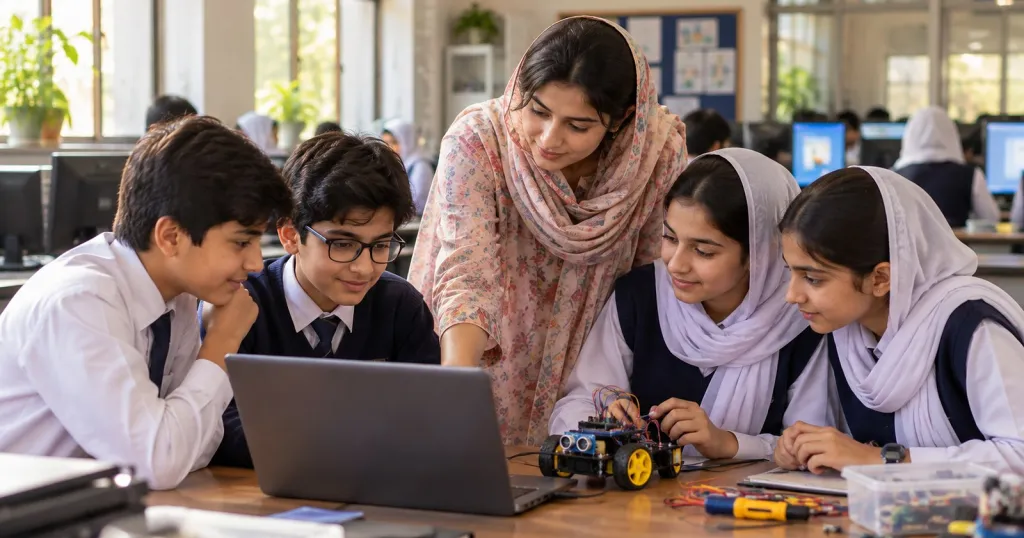
Islamabad's schools now teach AI, and HEC requires an AI course in every degree. What that means for a Class 6 child or a first-year student, and what to learn first.
This year a Class 6 student in Islamabad can choose AI instead of computer science, and HEC now requires an AI course in every university degree programme. At parent-teacher meetings, computer teachers keep hearing the same worried question: “Is my child already behind?”
Almost certainly not. Here is what has actually changed, what the subject looks like in a real classroom, and what to learn first. Very little of it needs an expensive laptop.
What has changed
The National Curriculum Council has notified an AI and Robotics curriculum for Grades 1 to 12, and Islamabad's schools and colleges were to start teaching it from the session that began in April 2026. With HEC's new rule for universities, the picture looks like this:
| Level | What the new rules say |
|---|---|
| Nursery to Class 5 | AI as a non-credit subject, with no exams |
| Classes 6 to 8 | Students choose computer science or AI |
| Classes 9 to 12 | AI as an elective; FBISE will include AI in its exams |
| University | A three-credit-hour AI course in every undergraduate and postgraduate programme, from the 2026 session |
Education is a provincial subject, so each province decides whether to adopt the school curriculum. In September 2026 Punjab announced plans for AI education from Class 1 to 12 and asked officials to prepare a curriculum. The HEC rule covers public and private universities, which may offer the course as an elective, an interdisciplinary course or a supporting course, so it can be shaped to fit each degree.
One more decision matters if you are choosing a degree. In June 2026 HEC suspended new admissions to computing programmes (computer science, software engineering, IT, AI, data science and cyber security) at 44 universities. It was part of a quality review linked to the National Skill Competency Test, taken by more than 33,000 final-year computing students, and it lasts until the evaluations are complete. Before you apply, check the programme's current status with the university and in HEC's latest notices.
What AI looks like in a Class 6 classroom
Forget the films. The curriculum's stated aims include computational thinking, intelligent systems, robotics, the ethical use of technology and problem solving. In a good classroom at this age, those big words turn into small, solid skills:
- giving clear, exact instructions, the way a machine needs them;
- spotting patterns and sorting things into groups;
- seeing how a computer “learns” from many examples, and how it can learn the wrong lesson;
- talking about what is fair, safe and honest when we use these tools.
That is good, old-fashioned thinking. A child who can explain making chai in ten exact steps has already started.
What it means for a first-year undergraduate
What the course covers will depend on your university and department. Whatever the syllabus, try to leave with three things:
- A clear idea of how these systems are built from data, and why they make confident mistakes.
- One honest use of AI in your own field: summarising long readings if you study law, checking code if you are an engineer, tidying survey data if you study business.
- Your university's rules on AI in assignments. Ask each teacher in the first week, in writing if you can, because the rules can differ from one course to the next.
What to learn first
Whether you are 11 or 19, the order is the same, and these five will still matter when today's apps are forgotten.
- Logic. Write instructions for an everyday task, then follow them exactly as written. Where they go wrong is where the learning is.
- Data. Read a table, work out an average, draw a simple bar chart. For two weeks, track the family's electricity units or a cricket team's scores.
- Using AI tools honestly. Ask a tool to explain a topic or to quiz you, not to write your homework. If you used it, say so.
- Checking answers. AI tools can be fluent and wrong at the same time. Check facts against your textbook, work the maths yourself, and be suspicious of anything too neat.
- A little Python. Twenty minutes a day for a month is enough to write a small quiz or a times-table game. Free tutorials and online editors run on a basic laptop.
What not to panic about
- A Class 3 child does not need a robot kit or a paid “AI for kids” course. Pencil, paper and a curious adult cover the early stages.
- Missing the latest app does not matter. Apps change every few months; logic, maths and clear writing do not.
- One phone shared by three children is enough to start. Most of the list above needs no screen at all.
- Maths is still the backbone. A student who is solid in algebra, ratios and basic statistics finds AI ideas far easier to follow.
What this could mean (our reading, not news)
The facts end here. What follows is our forecast, so read it as one.
- More schools are likely to add AI over the next few years, often before they have enough trained teachers. Expect uneven quality for a while, between schools and between provinces.
- Students who get the basics right are likely to gain most, whatever their school offers.
- Homework is likely to get harder to judge, and copying easier to hide. Families should be ready for schools to ask children to explain their work aloud, to do more writing in class, or to set AI rules.
- Computing applicants should expect closer checks on programme quality, so read HEC's notices before paying any admission fee.
House rules for AI at home
- The explain-it-back rule: if a tool helped with homework, your child explains the answer to you without the phone.
- AI in the shared room, not behind a closed door at midnight.
- No names, photos, phone numbers or school details typed into a chatbot.
- At the next school meeting, ask what the school's AI rules are. If it has none yet, ask anyway.
Tonight, try this. Ask your child to write the steps for making a cup of chai for a robot that has never seen a kitchen, then follow the steps exactly as written. You will both laugh, and you will see how your child thinks.
If your child needs a patient teacher for maths or computing basics, you can look for one on our Find my teacher page. And if you teach computer science yourself, you can apply to teach with us.
Sources
- Islamabad schools, colleges to teach AI from next academic session, Dawn (26 January 2026)
- The same Dawn report, republished by The State of Children in Pakistan
- From Class I to XII: Punjab puts AI on the curriculum, Express Tribune (25 September 2026)
- Pakistan's HEC mandates AI course in all degrees, Digital Pakistan (21 February 2026)
- HEC suspends admissions in computing programs at 44 universities, Eduvision (23 June 2026)