
Pre-medical, pre-engineering, ICS, I.Com, FA or A Levels? An honest comparison, the questions to ask yourself, how to talk to your parents, and why no choice is final.
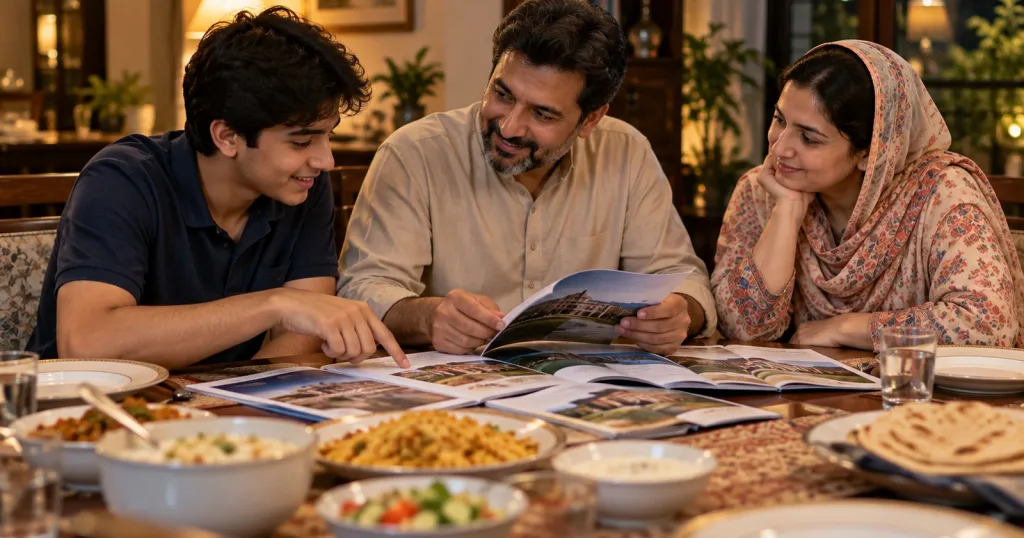
Somewhere in Class 10, usually over dinner, someone asks: “So, doctor or engineer?” Many students answer before they have really thought about it, because that is the answer the whole table is waiting for.
The group you choose after Matric does matter. It decides what you study for two years and which doors are easiest to walk through afterwards. But it is less final than it feels, and it deserves more than one dinner-table conversation.
The options, honestly
Subject combinations vary a little between boards and colleges, so read the prospectus of the college you want. In broad terms:
| Group | What you study | Usually leads to | Suits you if |
|---|---|---|---|
| FSc pre-medical | Biology, Chemistry, Physics | MBBS and BDS (after MDCAT), pharmacy, physiotherapy, nursing, allied health, life sciences | You like biology and can keep memorising steadily for years |
| FSc pre-engineering | Maths, Physics, Chemistry | Engineering (after ECAT or a university’s own test), computing, architecture, maths and physics degrees | Maths comes easily and you enjoy a hard problem |
| ICS | Computer Science and Maths, with Physics or Statistics (Economics in some colleges) | Computer science, software engineering, IT, data science; with Physics, engineering too | You like making things work on a computer |
| I.Com | Accounting, Commerce, Economics, Business Maths and Statistics, Banking | B.Com, BBA, accounting and finance, professional accountancy | You like practical numbers, money and how businesses run |
| FA (Humanities) | Three electives, such as Psychology, Economics, Civics, Education, a language or Fine Arts | Social sciences, languages, psychology, media, education, law, design | You read, write and argue well, and people interest you |
| A Levels | Usually three or four subjects you choose | Pakistani universities (with IBCC equivalence) and universities abroad | Your family can manage the cost and you study well on your own |
Three honest notes the table can’t hold:
- A Levels: to join a Pakistani college or university you need an IBCC equivalence certificate, and for a science group IBCC asks for three relevant A Level subjects (Physics, Chemistry and Biology for pre-medical; Physics, Chemistry and Maths for pre-engineering). Ask about the total cost, including exam fees, before you decide.
- Pre-medical is a long, crowded road. This September, 47,475 candidates sat MDCAT with UHS in Punjab alone. If you love biology, that is no reason to stop. If you don’t, it is a reason to think hard.
- FA is looked down on, unfairly. It is the natural route into law, psychology, journalism, teaching and much more, and it suits students who think in words.
The “doctor or engineer” question
Parents who push for medicine or engineering are usually not being unkind. They want security and respect for you, often because they had to work hard for both. Start there, with respect for what they want.
But a profession is what you do on ordinary days for most of your working life. A more useful question than “Which job do people respect?” is “Which work could I do well on a normal Tuesday, year after year?” Plenty of respected work has nothing to do with a stethoscope or a hard hat: accountancy, software, law, teaching, design, business, the civil service.
Questions to ask yourself
- Which subject do I do well in without anyone pushing me?
- Which subject do I still enjoy on a bad day?
- Do I prefer memorising and explaining, or working things out step by step?
- What does a normal day look like in the work I’m imagining? Have I asked someone who actually does it?
- Can my family manage the cost and the length of this route?
- If plan A doesn’t work out, what is plan B from the same group?
- Is this my own choice, or am I copying my friends?
Talking to your parents
Pick a calm evening, not results day and not in front of relatives. Do your homework first, then try something like this:
“Ammi, Abbu, I’ve thought about this properly. I’d like to do ICS, because maths and computers are where I do best. It leads to computer science and software engineering, and with Physics I can still apply for engineering. If that doesn’t work out, my backup is a BS in maths or statistics. What worries you about it?”
Then listen. Parents’ worries are usually practical: cost, distance, what relatives will say, whether there is a job at the end. Answer the practical ones with facts you have checked. If you get stuck, ask a teacher you both respect to sit with you.
It is not a life sentence
In recent years the rules have actually loosened. A few examples:
- Since 2023 the Pakistan Engineering Council has allowed ICS students who studied Physics, Maths and Computer Science to apply for engineering, with Chemistry to be cleared in the first semester.
- In 2024 it allowed pre-medical students to be considered for engineering after an eight-week maths bridging course.
- For BS computing programmes from 2026, HEC’s computing accreditation council (NCEAC) says students who did not study Maths in Intermediate can still join if they pass six credit hours of deficiency maths in the first year.
- From the 2026 Matric exams, IBCC has allowed students who passed Matric in the Arts group to register for FSc pre-medical and pre-engineering, with each board deciding how to apply it.
Universities and boards apply these rules in their own ways, so check the latest admission notice of the university or board you want. And beyond the rules, people change direction all the time: after a degree, through a master’s in another field, a professional qualification or a skill learnt alongside work.
This week, find one person who works in a field you are considering and ask them two things: what a normal day looks like, and what they wish they had known at sixteen.
If you want to test a subject before you commit, a few one-to-one lessons in FSc-level maths or biology will tell you a lot, and you can find a teacher on Education360. If Matric is still ahead of you, our post on the new 40% pass mark and study methods that work will help with the months ahead.
Sources
- A Punjab government college (gcwg.punjab.gov.pk): Intermediate programme and subjects
- IBCC: equivalence FAQs
- ProPakistani, 25 Sep 2026: UHS MDCAT 2026 result
- Eduvision, 5 Jun 2023: PEC declares ICS students eligible for engineering programmes
- Aaj News, 15 Jul 2024: pre-medical students can now opt for engineering degrees
- NCEAC (HEC), 22 Apr 2026: admission criteria for BS computing programmes (PDF)
- APP, 13 Dec 2025: Matric Arts students allowed into pre-medical and pre-engineering