A child’s recitation is shaped at home, fifteen quiet minutes at a time. The small habits that help most, and how to help even if you can’t read with tajweed yourself.
A child’s recitation is not really built in class. The teacher can fix a letter in a minute, but the fix only stays if the child says it correctly again the next day, and the day after that, at home.
Quran teachers can usually tell within a few lines which children practise a little every day. The difference is small habits, kept gently, for months.
Fifteen minutes, at the same time every day
For most young children, fifteen minutes is plenty. What matters more is the same time every day, so nobody has to argue about it. Tie it to something that already happens: after Fajr for early risers, after Maghrib in many homes, or after lunch, before the tuition rush.
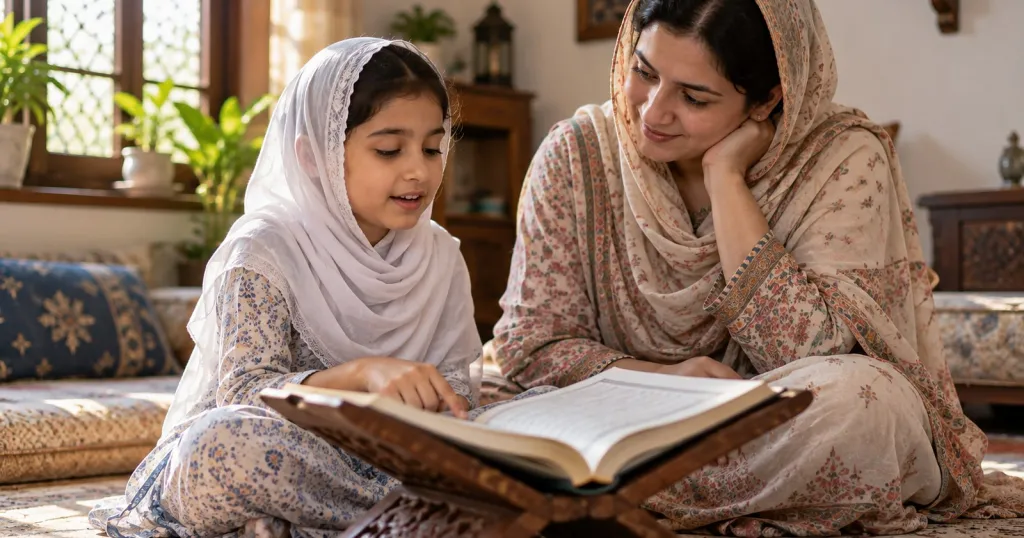
Keep the same place too: a clean corner, the rehal, the Qaida or Mushaf, and the phone on silent. For online classes, quiet matters even more: the teacher hears every letter through a microphone. Many families like the child to make wudu first, which makes the time feel special.
Stop while your child still wants a little more. A short session that ends well is the one they will happily sit down for tomorrow.
Listen first, then read
Children copy what they hear. If the only recitation a child hears all week is their own, small mistakes slowly turn into habits. Before reading, play a slow, clear recitation of the lines your child is learning and let them follow with a finger.
Ask the teacher which qari to listen to, so home and class sound the same. Recordings made for learners, where the qari pauses after each short piece so children can repeat it, are ideal. If your child learns online, the class recording works just as well.
The Quran itself asks for unhurried recitation: وَرَتِّلِ الْقُرْآنَ تَرْتِيلًا, “and recite the Qur’an with measured recitation” (Surah Al-Muzzammil, 73:4). So never hurry a child who is reading carefully.
One rule a week
Teach ten tajweed rules at once and a child remembers none. One rule, practised all week on the pages they already read, sticks. For little ones, one rule a fortnight is fine. Here is one gentle order; if your child’s teacher has a different plan, follow the teacher.
- Week 1, makharij (where each letter comes from). In Urdu, ح and ہ sound the same, and many of us say ق like ک. In the Quran they are different letters. ح comes from the middle of the throat and ه from its deepest part; ق is made further back on the tongue than ك. Listen for the ح in الْحَمْدُ, and notice that قُلْ (say) and كُلْ (eat) are two different words.
- Week 2, ghunnah (the hum in the nose). When a noon or meem carries a shaddah, the sound is held in the nose for about two counts, as in إِنَّ and ثُمَّ. Surah An-Nas is full of it: النَّاسِ, again and again. A test children enjoy: gently pinch the nose during the hum. If the sound stops, it was coming from the right place.
- Week 3, madd (the natural stretch). A long vowel is held for two even counts, no more and no less, as in قَالَ and يَقُولُ. Children either rush it or turn it into a song. Two fingers, two counts.
- Week 4, qalqalah (the small bounce). The letters ق ط ب ج د get a slight bounce when they carry a sukoon. Surah Al-Ikhlas is perfect practice: لَمْ يَلِدْ وَلَمْ يُولَدْ.
Yesterday’s page before today’s
Many hifz teachers in Pakistan use three words: sabaq for the new lesson, sabqi for the recent ones and manzil for the older ones. Nazra needs the same idea, in a smaller size. Before anything new, your child reads yesterday’s lines once, slowly. It takes four minutes.
A fifteen-minute session can look like this:
- 4 minutes: read yesterday’s lines.
- 3 minutes: listen to today’s lines and follow with a finger.
- 6 minutes: read today’s lines, with this week’s rule in mind.
- 2 minutes: your child recites a favourite surah to you.
Once a week, record your child on the phone and listen together. Children catch their own mistakes quickly, and hear their progress too.
Praise the effort
Some children have sweet voices and some don’t. A voice says nothing about how well a child is learning. Praise what they actually did: “Your ح was clear today.” “You held the ghunnah for the full two counts.”
Share this hadith with them too, especially on a hard day: “One who is proficient in the Qur’an is associated with the noble, upright, recording angels; and he who falters in it, and finds it difficult for him, will have two rewards” (Sahih Muslim, 798). Finding it hard is part of learning, and it is rewarded.
A few things quietly undo the good work:
- Comparing your child with a cousin who “finished the Quran at seven”.
- Giving extra pages as a punishment. The Quran should never be the punishment.
- Pushing on when your child is exhausted. Ten good minutes beat twenty tearful ones.
If you can’t read with tajweed yourself
Many parents learnt to read the Quran as children, quickly and without tajweed. You can still help a great deal. You don’t have to be the teacher: keep the time, sit beside your child and listen. That is most of the job.
- Follow the recording with your own finger, so your child sees you learning too.
- Ask your child to teach you this week’s rule. Children love being the teacher, and catching Abbu out on a ghunnah is the highlight of their week.
- If something sounds different from the recording, don’t correct it yourself. Note the page and line on a slip of paper and ask the teacher: “Could you check page 12, line 5? I wasn’t sure about the madd.”
- Learn alongside your child. It is never too late to start tajweed, and children notice when Ammi or Abbu is learning too.
Tonight, choose the time, put out the rehal and play one slow recitation of your child’s lesson. That is the whole first step.
If you are still choosing a teacher, our guide to online Quran classes for children explains what to listen for in a trial class. When you know what your child needs, you can find a teacher on Education360.