
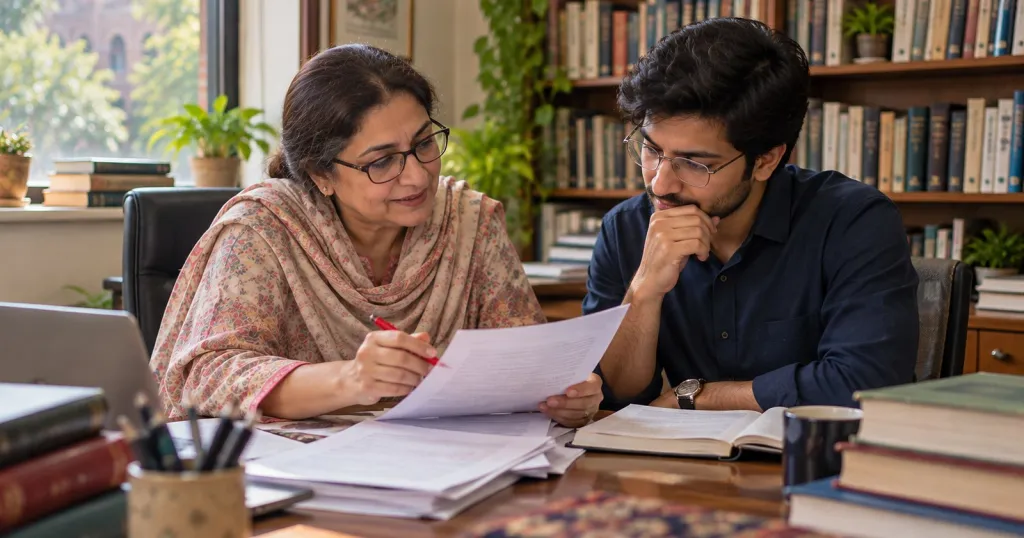
Before a supervisor signs your MPhil or PhD proposal, they run through a short list in their head. Here is that list, and the reasons proposals most often come back.
In many Pakistani departments the research proposal is called the synopsis, and the next few years of your work stand on it. Before a supervisor signs it and sends it to the departmental committee, they run through a short list in their head. Most proposals that come back were not badly written. They were badly planned.
Here is that list. Run it yourself first, and the red pen will have far less to do.
The supervisor's checklist
1. A narrow question
“The impact of social media on students” is a field, not a question. A workable version names who, what and where: “How do first-year BS students at two public universities in Peshawar use WhatsApp groups for coursework?” Test yours. Can you write it as one sentence ending in a question mark? Could you answer it with data you can really collect in the time you have?
2. Why it matters, and to whom
Write the “so what” paragraph in three or four sentences. Who will use your answer: teachers, a hospital, farmers, a district office? Leave out claims like “this study will benefit the whole nation”. A clearly local problem counts in your favour.
3. What is already known
The literature review in a proposal is short, and it is an argument, not a list. Avoid “Author A (2019) found… Author B (2020) found…”. Group the studies by theme, say what each group shows and what it leaves open, and finish on the gap your question fills. Read mostly recent work, plus the few older papers everyone in your area cites.
Search Google Scholar and, through your university library, the HEC Digital Library. Look at your department's past theses too, so you don't repeat one. Keep a reading table with five columns (paper, question, method, finding, limitation); it turns into your review almost by itself.
4. A method that fits the question
“How many”, “how much” and “is there a relationship” questions need numbers: a survey, an experiment, existing records. “How” and “why” questions usually need words: interviews, focus groups, observation. If you need both, say how the two parts connect. A common mismatch is a “why” question answered with a rating scale.
Your committee will also ask: who are your participants, how many, how will you choose them and why that number? Where does your questionnaire come from (adapted from a published one, with permission)? How will you translate it into Urdu or the local language and check the translation? Will you pilot it first? Name your analysis now, whether it is a regression or a thematic analysis. “Data will be analysed in SPSS” is not a plan.
5. Feasibility and a timeline
This is where enthusiastic proposals fall over. Check access (will the school, hospital or office give you a permission letter?), money, travel, lab time, languages and your own skills. Check the calendar too: schools close for winter and summer holidays, exams empty classrooms, and Ramadan changes everyone's hours. Then make a timeline. Here is a sample for a one-year MPhil thesis; your department's rules decide the real length.
| Months | Work | What you have at the end |
|---|---|---|
| 1–2 | Finish the review, finalise the questionnaire | Review draft, final questionnaire |
| 3 | Ethics approval, permission letters, pilot | Approval, pilot notes |
| 4–6 | Data collection | A clean data file or transcripts |
| 7–8 | Analysis | Results tables or themes |
| 9–10 | Writing | A full draft |
| 11–12 | Revisions, similarity check, submission | The final thesis |
6. Ethics
If your study involves people, plan for consent in a language they understand, a clear right to refuse or stop, no names in your data, and safe storage. Take extra care with children (a parent's consent and the child's own agreement), with patients, and with anyone who may find it hard to say no to you, such as your own students or staff. Find out what your university's ethics committee needs, get its approval before you collect any data, and attach your consent form.
7. References that are real, recent and consistent
Use one style throughout: APA, or whatever your department asks for. Every citation in the text must be in the list, and every item in the list must be cited. Check that a journal is recognised in HEC's Journal Recognition System (HJRS), and be wary of any journal that promises publication within days for a fee. A free reference manager such as Zotero saves hours.
A word on AI tools. In a 2023 study in Scientific Reports, 55% of the references produced by ChatGPT's GPT-3.5 model were fabricated, and 18% of those from GPT-4; many of the real ones contained errors. The tools have changed since, but the rule has not: open every source you cite and read at least its abstract. A supervisor who finds one invented reference starts doubting all the others.
Why proposals come back
- The title, question, objectives and method don't match one another.
- The topic is a whole field, with no single question.
- Objectives that can't be measured, such as “to explore all aspects of…”.
- A literature review that lists papers and never reaches a gap.
- A sample size with no reason given.
- Too much for the time: four districts, a thousand respondents and one year, with no budget.
- No ethics section or consent form.
- Copied or lightly reworded text, or references that don't exist.
- The department's template ignored, and references in three different styles.
Before you send it
Write a one-page version first: title, question, why it matters, method, data and timeline. Show it to your supervisor before you write twenty pages. Changing direction at one page costs an afternoon; at twenty pages it costs a month.
Then give your question to a friend from a different subject and ask them to tell you, in their own words, what you are going to do. If they can't, change the question, not the friend.
Start today with the first item: write your question as a single sentence and hold it against the checklist above.
Preparing for the admission test as well? Our guide to HAT and GRE preparation for 2027 MPhil and PhD admissions covers that side. And if you want help with research methods, statistics or academic writing, you can find the right teacher on Education360.