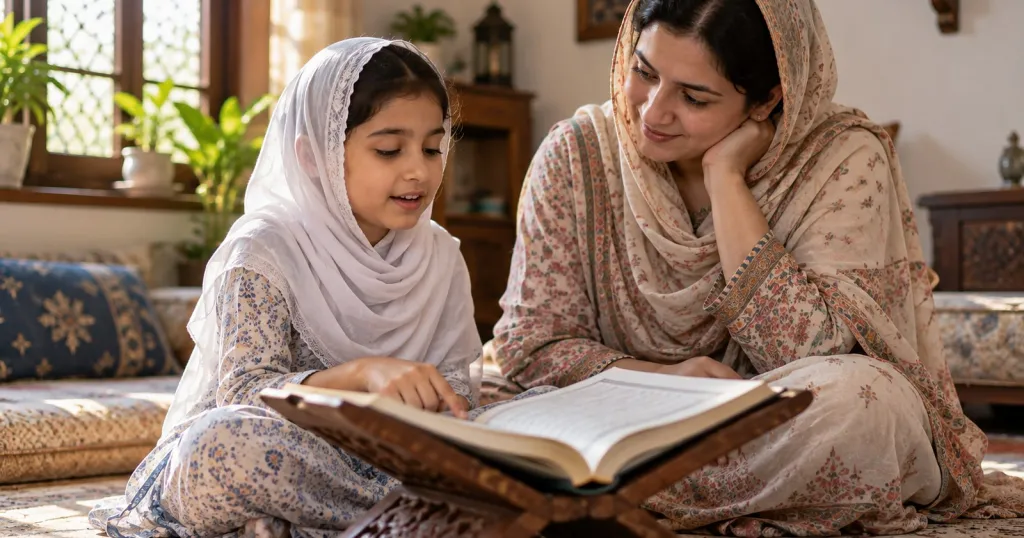
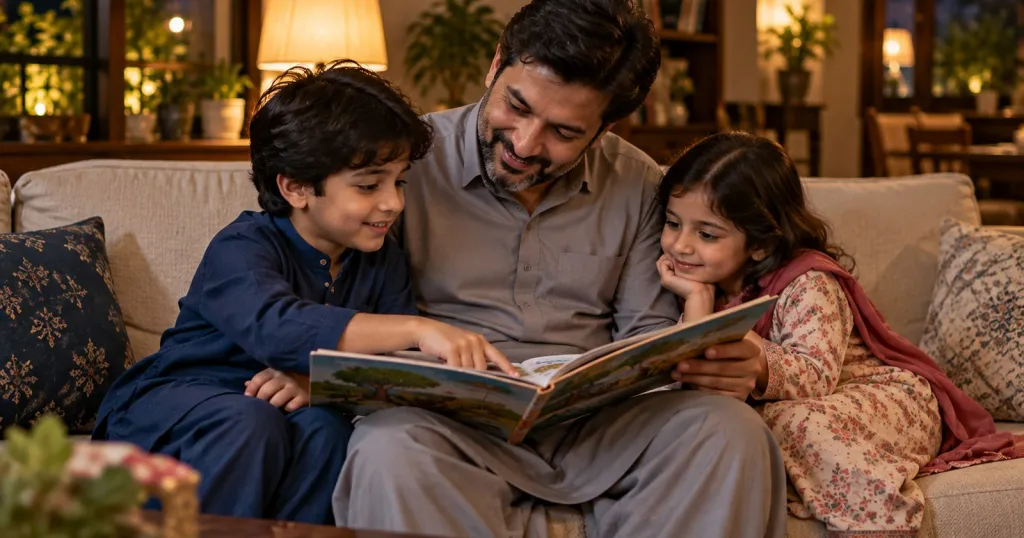
Fifteen minutes a day with a book, a comic or even a shop board. What to read, how to listen without correcting every word, and a weekly chart you can copy tonight.
Primary teachers know this moment well. A Class 1 child “reads” a whole page of the Urdu book perfectly, eyes on the picture. Point to one word in the middle, and there is a long silence. The page has been learnt by heart.
That is normal at first. But reading means working out a word you have never seen, a skill built at home as much as at school.
In the ASER 2025 survey, only about half of Class 5 children could read a story meant for Class 2 in Urdu or Sindhi. Classes 1 to 3 are where that gap opens, or never does.
Fifteen minutes, most days
Fifteen minutes fits into any school night, even during load-shedding with a rechargeable lamp. Tie it to something that already happens: after Asr, after dinner, or at bedtime. Same time, same corner, phones face down, yours too. End on a good page, not a tired one.
Don’t panic over a missed day. In 14 countries, the OECD’s PISA study found that 15-year-olds whose parents read with them in their first year of primary school, daily or even once or twice a week, scored higher in reading than those whose parents rarely did, even allowing for family background.
What to read: more than the school book
A child who only reads the textbook learns that reading means homework. Mix it up:
- Story books in Urdu and English: easy ones your child reads to you, harder ones you read aloud to them.
- Comics and children’s magazines count. Many children who “hate reading” happily read comics.
- Words around you: shop boards, biscuit packets, wedding cards, the cricket score, the poetry on the back of a truck (choose your truck with care).
- Newspaper headlines, big and short, suit Classes 2 and 3; one at breakfast is plenty.
- No books at home? StoryWeaver, a free online library, has stories in Urdu and English to read on a phone or print.
How to read together
Run your finger under the words as you read: right to left in Urdu, left to right in English. A Class 1 child is learning both at once, which is no small thing. Then hand the finger over.
Share the reading by class:
- Class 1: you read most; your child reads the words that keep coming back (“the” and “and”, or ہے and اور).
- Class 2: take turns, a page each.
- Class 3: your child reads, you listen.
Stop at the exciting part: “What happens next?” Ask questions with no single right answer: “What would you have done?” A favourite read for the tenth time is fine; re-reading helps speed and expression.
A younger brother or sister makes a perfect audience: the older child slows down and reads with feeling, and the little one gets a story. Dadi or a row of dolls also works.
Above all, let your child read to you. A review of 16 studies (1,340 families, KG to Class 3) found that reading improved when parents listened to their children read, and more when they practised specific skills such as letter sounds. Where parents only read to them, there were no significant gains. Keep the bedtime story, and add your child’s turn.
Don’t correct every word
The most common mistake comes from love. Picture a Class 2 child stopped at every second word: soon she reads in a whisper, watching your face instead of the page. Reading specialists suggest pause, prompt, praise instead:
- Pause. When your child is stuck, wait three to five seconds. If they misread a word, let them finish the sentence; they often fix it themselves.
- Prompt. A hint, not the answer: “Look at the first letter. What sound does it make?” In Urdu: “Is there a zabar or a zer?” After two hints, say the word and move on.
- Praise. Be specific: “You sounded that out by yourself.”
Small slips that don’t change the meaning can wait. Also skip spelling tests on every page, reading as punishment (“No cartoons, go and read”), comparisons with cousins, and 9 pm sessions with drooping eyes.
If the school teaches phonics, use the same letter sounds at home: a child taught “buh” at school and “bee” at home gets confused.
If you don’t read English well
Many parents studied in Urdu-medium schools, and many grandparents never went to school. You can still do most of this job. In the OECD’s words, “it doesn’t take a PhD or unlimited hours.”
- Read in the language you read best, and talk about the pictures in Urdu, Punjabi, Pashto or Sindhi. As the World Bank puts it, “Children learn best when taught in a language they understand,” and that is the strongest base for a second language.
- For the English book, let your child be the teacher: “Read it to me, then tell me in Urdu what happened.” If they can explain it, they understood it.
- Ask the teacher for a voice note of the lesson on the class WhatsApp group, or let an older cousin take the English book twice a week.
A simple weekly chart
Draw this in a notebook and stick it on the wall at your child’s height. One example week:
| Day | What we read | Minutes | New word |
|---|---|---|---|
| Mon | Urdu book: The Thirsty Crow | 15 | kankar (pebble) |
| Tue | Bazaar shop boards | 10 | bakery |
| Wed | English picture book | 15 | enormous |
| Thu | Story for little brother | 15 | tortoise |
| Fri | Newspaper: the weather | 10 | forecast |
| Sat | Comic | 20 | rocket |
| Sun | Favourite book, again | 15 | child’s choice |
Let your child fill it in; in Class 1, a star is enough. A missed day gets a blank, not a scolding. On Sunday, count the stars and let your child choose next week’s first book.
If your child still struggles with letter sounds after a term, or holds books very close, talk to the class teacher; sometimes the answer is an eye test.
Tonight, find one thing with words on it, a storybook, a comic, even the biscuit packet, and let your child read it to you. Count to five before you help.
For extra help, you can find a patient teacher for their class in five taps; our checklist for choosing an online tutor helps you choose well.
Sources
- UKFIET: Beyond enrolment, Pakistan’s real education crisis is learning (ASER 2025)
- OECD: The parent factor in student performance (PISA 2009)
- Sénéchal and Young (2008), Review of Educational Research
- Five from Five (MultiLit): Home reading
- World Bank: Loud and Clear report (2021)
- StoryWeaver (Pratham Books): free storybooks, including Urdu