One report says 25 million Pakistani children are out of school; a reading of ASER 2025 says about 5 million. Why they differ, what both say about learning, and what you can do.
Two numbers keep turning up in newspapers and family WhatsApp groups. One says 25 million children in Pakistan are out of school. The other says about 5 million. Both come from serious people, and they cannot both be measuring the same thing.
People who work on literacy surveys learn to ask a few boring questions before believing any number. Let's ask them, then come to what matters more: the children on your own street.
What was reported
The 25 million figure
A policy review by the Civil Services Academy, reported in July 2026, puts the number of out-of-school children at 25.1 to 26 million. Punjab has the largest share, 9.6 to 10.4 million; the province's own 2026 baseline counts 6.4 million children who never enrolled and 3.16 million who dropped out. The review notes that a National Education Emergency was declared on 8 May 2024 and every province has a roadmap under the National Education Action Plan 2026. Its main point: the plans exist, and carrying them out is the hard part.
The 5 million figure
In March 2026 Gallup Pakistan analysed ASER 2025, a large national survey whose sampling was done by the Pakistan Bureau of Statistics. ASER found 92.2% of children aged 6 to 16 in school and 7.7% out of school. Out of about 66 million children of that age, that is roughly 5 million. Gallup argues that the 25 million figure is out of date.
Why the numbers differ
Nobody has to be lying for both numbers to exist. They answer slightly different questions, in different years, in different ways.
- Ages. The 2023 census counted 25.37 million out-of-school children aged 5 to 16, about 35.6% of that age group: close to the familiar 25 million. ASER counts ages 6 to 16. Leaving out the five-year-olds, some of whom have simply not started yet, lowers the count.
- Years. The census is from 2023 and ASER from 2025. Even the government's Pakistan Economic Survey 2025–26 shows the share falling, from 38% in 2023 to 28% in 2025. A falling share does not always mean fewer children, though: from 2016–17 to 2021–22 the official share fell from 44% to 39% while the number rose from 22 million to 26.2 million, as the population grew.
- Counting or sampling. A census tries to reach every household; a survey visits a carefully chosen sample and scales up. Both are legitimate, with different kinds of error.
- What counts as “in school”. Is a child whose name is on the register but who rarely attends “in school”? A child in a madrassa or a non-formal centre? With about 66 million children aged 6 to 16, every 1% is roughly 660,000 children, so small differences in the question move the total a lot.
Here is a quick test for any education number forwarded to you: which ages, which year, who collected it, counted or sampled, and what counted as “in school”? If the message can't answer, don't forward it.
What both numbers agree on
Being on a school register is not the same as learning. ASER 2025 found that only about half of Class 5 children could read a story meant for Class 2 in Urdu or Sindhi, and about half could do a simple division. A Pakistan Institute of Education report in March 2026 said 77% of ten-year-olds cannot read and understand a simple text.
Whichever figure is closer to the truth, millions more children are in classrooms without learning to read well. Both numbers point at that.
What this could mean (our reading, not news)
- The argument over the number is likely to go on until a new census or national survey settles it. Until then, treat any single figure with care, including the one you like.
- Attention is likely to shift from enrolling children to keeping them in school and teaching them to read, since the roadmaps already exist.
- Children who are enrolled but can't read well are likely to be the next drop-outs, especially when a family needs another pair of hands.
What you can do this month
Read with one child
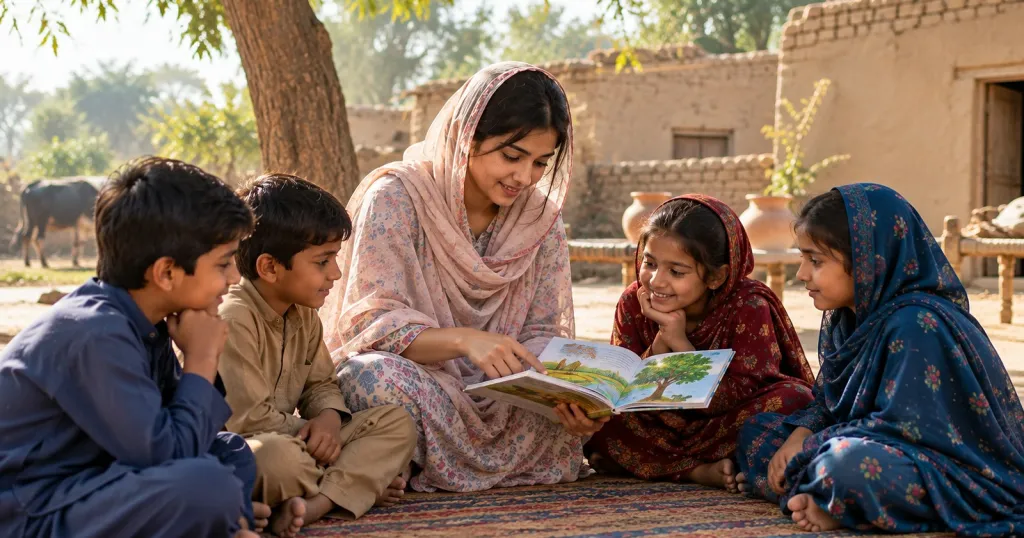
Fifteen minutes, three times a week: a younger cousin, a neighbour's child, or the child of someone who works for your family, if the parents would like it. Any Urdu storybook or Class 2 Urdu book will do. Let the child point at the words, ask “What happens next?”, and resist correcting every word.
To see where a child stands, ask them to read a short paragraph from a Class 2 Urdu book. Slow but correct is fine. If they know their letters but can't read words, start with words.
Keep a struggling child in school
- Parents: if marks are slipping, see the class teacher in the first month of term, not after the result.
- Teachers: when a child misses three days in a row, call the family that week. A call from a teacher can be what brings a child back.
- Twenty minutes a day of reading or times tables at home is worth more than a month of pressure before exams.
Flexible learning for working children
A boy who works in a workshop, or a girl who looks after younger siblings, may not manage a full school day. Ask the district education office or a local community school whether there is an evening, non-formal or accelerated class nearby for older children who missed years. Saved lessons on a phone, and an hour after work with a patient neighbour, count too.
Make the way to school safe for girls
Girls are still more likely to be out of school than boys: 31% against 25% in 2025, by the Economic Survey's count. For many families the real worries are distance and safety, and those worries deserve respect, not lectures. Practical answers help most: girls walking together, a trusted adult or a shared van for the long stretch, a school or a woman teacher closer to home, and a clear conversation with the school about timings.
Pick one child this week. Fifteen minutes with a storybook won't change a national figure. It can change what one child believes they can do.
If a child in your own family is falling behind, a patient teacher early on helps more than a tuition rush in Class 9. You can look for one on our Find my teacher page.
Sources
- Over 25 million children remain out of school: policy report, Dunya News (6 July 2026)
- Out-of-school children are now 5 million, not 25 million (ASER 2025), Gallup Pakistan (31 March 2026)
- Census 2023 key data, Pakistan Bureau of Statistics
- Out-of-school share fell to 28% in 2025 (Economic Survey 2025–26), ProPakistani (11 June 2026)
- Out-of-school children figures clock in at 26 million, The News (21 January 2024)
- Beyond enrolment: Pakistan's real education crisis is learning, UKFIET (28 May 2026)
- 77pc of 10-year-olds unable to read and understand simple text, Dawn (5 March 2026)