
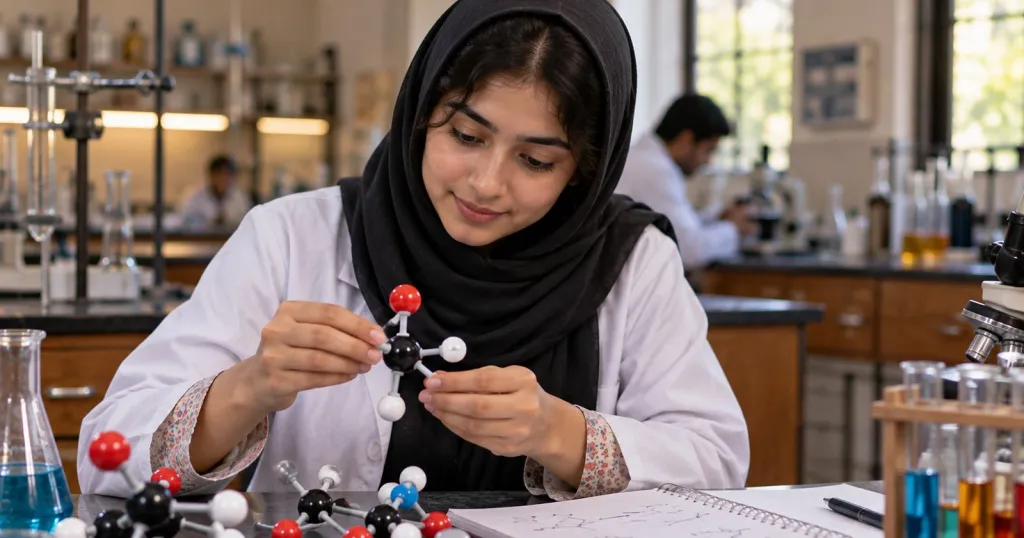
Forty reactions learnt by heart fall apart when the question changes shape. Learn a few patterns instead: what attacks what, what each reagent does, and one map that links them.
Picture an FSc student in November with forty organic reactions copied neatly into a register. Ask for reaction seventeen and it comes out word-perfect. Then the paper says “Convert ethene into ethanoic acid”, and the page stays blank, because that exact line was never in the register.
Chemistry teachers see it every year. Ratta (learning by rote) stores answers, but exams ask questions. Learn the few patterns underneath instead, and the reactions start to explain themselves.
Start with the functional group
The functional group decides how a molecule behaves. Even a big, complicated molecule with one C=C bond reacts like an alkene. So first, find the group and circle it.
- C=C: alkene. C≡C: alkyne.
- A benzene ring: an aromatic compound.
- C–X, where X is a halogen: alkyl halide.
- OH on a carbon chain: alcohol.
- C=O at the end of a chain: aldehyde. In the middle: ketone.
- COOH: carboxylic acid. COO joining two chains: ester.
Practise until you can spot each one in three seconds. It sounds too small to matter, but it is the step most students skip.
One question: what attacks what?
Nearly every reaction in your book tells the same story: something rich in electrons meets something short of them. Nucleophiles (OH⁻, CN⁻, H₂O, NH₃) are electron-rich and look for a slightly positive carbon. Electrophiles (H⁺, NO₂⁺, a polarised Br₂) are electron-poor and look for a crowd of electrons. Put that beside the functional groups and four patterns appear:
| Group | What it is like | Who attacks it | Usual reaction |
|---|---|---|---|
| Alkene (C=C) | Electron-rich double bond | Electrophiles: H⁺, Br₂ | Addition |
| Benzene ring | Electron-rich, very stable | Electrophiles: NO₂⁺, Br⁺ | Substitution, so the ring survives |
| Alkyl halide (C–X) | Carbon slightly positive | Nucleophiles: OH⁻, CN⁻, NH₃ | Substitution or elimination |
| Aldehyde, ketone (C=O) | Carbon slightly positive | Nucleophiles: CN⁻ | Addition |
So adding HBr to propene, nitrating benzene and adding HCN to ethanal are one idea in three places: an attacker finding its target. In a mechanism, the curly arrow always starts at the electrons.
Treat reagents as tools
Think of each reagent as a tool with a job (a few have more than one). Learn the job once and you can read reactions you have never seen. Keep this list at the back of your register:
- Acidified K₂Cr₂O₇ or KMnO₄ (oxidises): primary alcohol to aldehyde, then carboxylic acid; secondary alcohol to ketone; tertiary alcohols resist. Dichromate turns from orange to green.
- H₂ with a nickel catalyst (adds hydrogen): alkenes and alkynes become alkanes.
- Aqueous KOH (swaps): replaces the halogen of an alkyl halide with OH, giving an alcohol.
- Alcoholic KOH (strips off H and X): gives an alkene. Memory hook: water swaps, alcohol strips.
- Concentrated H₂SO₄ with heat (removes water): turns an alcohol into an alkene, and catalyses ester formation.
- Bromine water (tests for C=C): its orange-brown colour disappears.
- Tollens’ reagent (tests for aldehydes): a silver mirror with aldehydes, nothing with ketones.
When a new reaction turns up in class, ask “which tool is this?” before you memorise anything.
Draw one reaction map
Take a sheet of chart paper, or the inside cover of your register. Write the functional groups in boxes and join them with arrows, with the reagent and condition on each arrow. Start with two-carbon compounds:
- Ethene to bromoethane: HBr (addition)
- Bromoethane to ethanol: aqueous KOH (substitution)
- Bromoethane to ethene: alcoholic KOH (elimination)
- Ethanol to ethene: concentrated H₂SO₄ and heat (water removed)
- Ethanol to ethanal, then ethanoic acid: acidified K₂Cr₂O₇ (oxidation)
- Ethanoic acid and ethanol to ethyl ethanoate: concentrated H₂SO₄ (an ester)
Now the blank-page question has a route. Ethene to ethanoic acid: HBr gives bromoethane, aqueous KOH gives ethanol, and acidified K₂Cr₂O₇ oxidises it fully. You never memorised that answer. You read it off the map.
Pin it where you study and add an arrow for every new reaction.
Naming practice, five a day
Easy marks slip away on names. IUPAC naming is a short routine:
- Find the longest carbon chain that contains the functional group.
- Number it from the end nearer that group.
- Name the side groups with their numbers, alphabetically.
- Add the group’s ending, such as -ol, -al, -one or -oic acid.
So CH₃CH(CH₃)CH₂OH is 2-methylpropan-1-ol. If your book prints the older style, 2-methyl-1-propanol, follow your book. Papers still use common names too: acetone is propanone, acetic acid is ethanoic acid.
Ten minutes a day: five structures to name, five names to draw. Swap sets with a friend on WhatsApp and mark each other’s.
Flashcards and spaced recall
Rereading your notes feels like studying, but testing yourself works far better. A large 2013 review of study techniques gave its highest rating to just two: practice testing, and spreading study out over time. Rereading and highlighting were rated low.
So make small cards. Front: “Bromoethane + alcoholic KOH gives?” Back: “Ethene, by elimination. Aqueous KOH would give ethanol.” Answer out loud before you turn the card.
Review each new card the next day, then after three days, a week and two weeks. Get it wrong and it goes back to the start. A shoebox with a few dividers does the job.
Use past papers the right way
Collect the organic questions from your board’s last five years of past papers and sort them by type. The same few usually come back:
- Complete the reaction: give the product.
- Convert A into B: find the route on your map.
- Distinguish two compounds: name the reagent and what you would see. Tollens’ reagent gives a silver mirror with ethanal, nothing with propanone.
- Mechanisms: curly arrows from the electrons to the target.
- Names and structures.
Practise one type at a time, against the clock, and turn every wrong answer into a new arrow or card. If your notes and the prescribed textbook disagree on a condition, write what the textbook says and check with your teacher.
Keep the lab on paper
None of this needs an experiment at home. Concentrated acids and many organic liquids are dangerous outside a proper lab, so leave practical work to your college and your teacher.
Tonight, draw the two-carbon map from memory, then check it against the book. The gaps are tomorrow’s study plan.
If you’d like a teacher to check your map and past-paper answers with you, you can look for one on Education360. For more on testing yourself, read our guide to study methods that work.