
Academic or General Training, how long you really need, where marks go missing in each module, and a six-week plan with mock tests. For dates and fees, use the official sites.
Many IELTS candidates arrive with three things: a deadline, a cousin’s advice and a folder of photocopied practice tests. The deadline is real. The advice needs checking. The folder is useful once you know what to do with it.
Here is the shape of the test, how long to give it, where marks usually go missing, and a six-week plan. One rule first: for test dates, fees and the band you need, trust only the official sites and the organisation you are applying to. Those things change. WhatsApp forwards don’t.
Academic or General Training
IELTS Academic is for university study and professional registration. General Training is for migration, and for training or study below degree level. Listening and Speaking are the same in both; Reading and Writing differ. Some UK visa routes ask for a version called IELTS for UKVI.
Which test and which band you need is decided by whoever receives your score: the university, the regulator or the immigration authority. Read their own page before you book. If a forward and that page disagree, the page wins.
How long do you need?
Before you spend a rupee, take one full official practice test under timed conditions. Your four section scores show you the size of the gap.
- If you are within half a band of your target, six focused weeks of learning the test can be enough.
- If you need a whole level more English, think in months. Cambridge English puts B1 at roughly 350 to 400 hours of guided learning from the very beginning and B2 at 500 to 600, and calls these figures a guideline only. B2 corresponds to about IELTS 5.5 to 6.5.
The gap between those two levels, 150 to 200 hours, is five to seven months at an hour a day. Measure the gap first, then book the date.
The four modules, and where marks go missing
Listening: about 30 minutes, 40 questions
You hear each recording once only, so practise that way from the first day. Spelling is the easiest place to lose marks: a misspelt answer is marked wrong, even if you heard the word perfectly. British or American spelling is fine as long as you stick to one. Start a spelling list this week, beginning with “accommodation” and “environment”.
Reading: 60 minutes, 40 questions
The usual trap is reading every word of a passage before looking at the questions, then losing ten minutes to one hard question. In Academic Reading, give each of the three passages about 20 minutes and move on. For True, False and Not Given, judge only by what the text says, not by what you know about the world. Respect word limits too: writing more than the instruction allows loses the mark.
Writing: 60 minutes, two tasks
Task 1 needs at least 150 words in about 20 minutes, Task 2 at least 250 words in about 40. Task 2 counts twice as much as Task 1, so half an hour spent polishing Task 1 is time stolen from the task that matters more.
In Task 2, trainers see three habits again and again: a memorised opening (“In this modern era of science and technology…”) that says nothing, sitting on the fence when the question asks how far you agree, and three thin paragraphs instead of two developed ones. A shape that works:
- Introduction: the question in your own words, and your clear answer.
- First body paragraph: one main reason, explained, with an example.
- Second body paragraph: a second reason, or the other side and why you still hold your view.
- Conclusion: two sentences that restate your position in fresh words.
Speaking: 11 to 14 minutes, face to face
Speaking is a recorded conversation with an examiner, in three parts. In Part 2 you get one minute to prepare and then speak for two minutes. Fluency and coherence, vocabulary, grammar and pronunciation carry equal weight.
Pakistani candidates who studied grammar carefully at school often stop mid-sentence to repair a tense, or answer in one line and wait. Keep going: a small slip costs less than a long silence. Your accent is not marked against you; being clear is what counts. Prepare ideas, not scripts, and use the Part 2 minute to jot down five words, not sentences. A few local habits are worth dropping because they are grammar errors in standard English: “I am having two brothers” (I have), “discuss about” (discuss) and “return back” (return).
A six-week plan
Allow about 90 minutes on weekdays and a longer block at the weekend.
| Week | Focus | Every day |
|---|---|---|
| 1 | One full practice test; find your weakest module | One listening section with its transcript; ten spellings |
| 2 | Listening and Reading technique, timed | One reading passage in 20 minutes; check every wrong answer |
| 3 | Writing Task 2: plan two essays a day, write three a week | Record two minutes of Part 1 answers on your phone |
| 4 | Writing Task 1 and Speaking Part 2 | One cue card: a minute to plan, two to speak, recorded |
| 5 | Two full mock tests on a computer | Fix the mistakes from the last mock |
| 6 | One last mock early in the week, then lighter practice | Sleep properly; rest the day before |
Mock tests: make them feel like the real thing
In Pakistan, the British Council and IDP both list IELTS on computer, and the British Council offers paper only to candidates approved for special consideration on medical grounds. So practise on a computer: type your essays and read passages on a screen. The British Council has free practice tests and an IELTS on computer familiarisation test.
- Sit Listening, Reading and Writing back to back. On test day there are no breaks between them.
- For Speaking, ask a friend to read the questions and keep time, or record yourself and listen the next day.
- Get your essays marked by someone who knows the band descriptors. Marking your own writing is where most people are kindest to themselves.
If one module lets you down in a computer test, ask about One Skill Retake: where a centre offers it, you can retake one section within 60 days. Check first that your university or visa route accepts it.
Before you pay anyone
Book only through the British Council or IDP. Anyone selling an IELTS certificate without the test is running a scam, and organisations verify results online. For this month’s dates and fees, go to British Council Pakistan or IDP IELTS Pakistan.
This week, take one free official practice test under timed conditions and write your four scores on a card. That one evening tells you whether you need six weeks or six months.
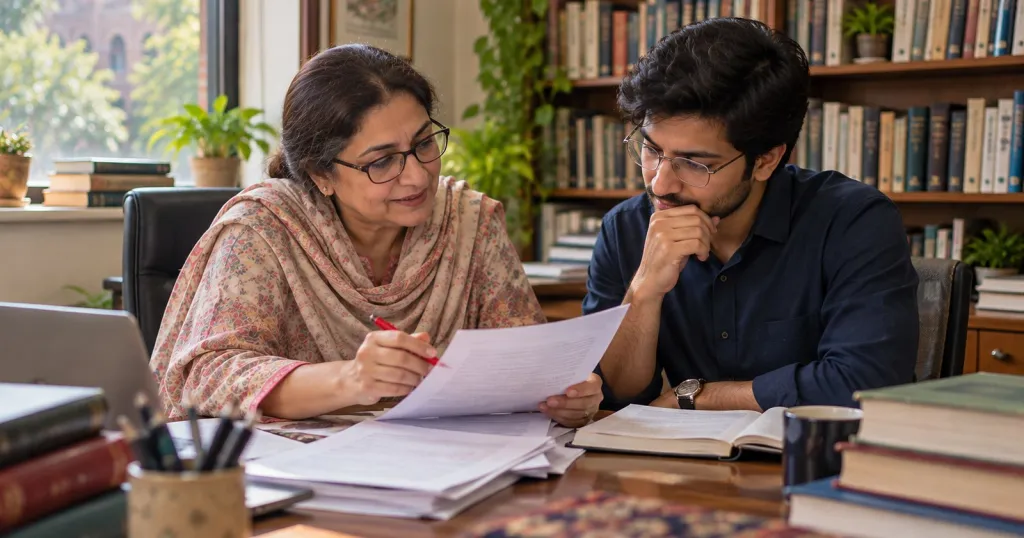
If you would like a teacher to mark your essays and run speaking mocks with you, you can find the right teacher in five taps.
Sources
- IELTS test types, ielts.org
- Academic Listening format, ielts.org
- Academic Reading format, ielts.org
- Academic Writing format, ielts.org
- Academic Speaking format, ielts.org
- IELTS scoring in detail, ielts.org
- IELTS and the CEFR, ielts.org
- Guided learning hours, Cambridge English
- 9 myths about the IELTS Speaking test, IDP IELTS Pakistan
- Spelling in IELTS Reading, Listening and Writing, IDP IELTS
- IELTS test format, British Council
- IELTS dates and locations in Pakistan, British Council
- Book your IELTS test in Pakistan, British Council
- IELTS test dates, fees and venues, IDP IELTS Pakistan
- Free IELTS practice and sample tests, British Council
- IELTS One Skill Retake, ielts.org
- Beware of IELTS scams, IDP IELTS