
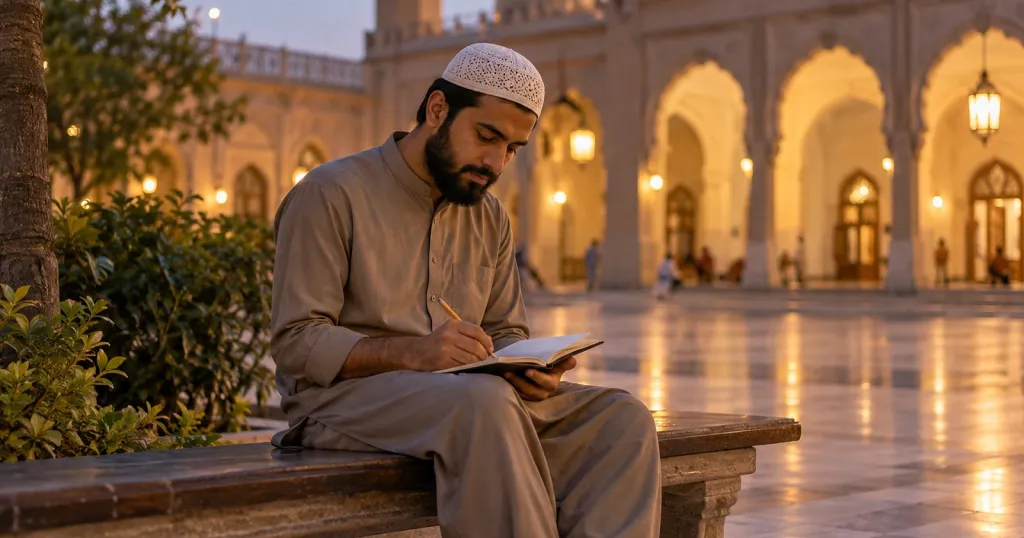
You can read the Quran fluently but the meaning passes you by. Begin with the words that repeat, a few roots and patterns, and 20 minutes a day with surahs you know.
Many of us learnt to read the Quran as children: Qaida first, then Nazra, perhaps with a Qari sahib who corrected every makhraj. We can recite fluently, sometimes beautifully. And then we stand in prayer and the words pass by like a language we love but do not speak.
If that is you, the gap is smaller than it feels. You already read the script, and if you speak Urdu you already know a surprising amount of the vocabulary. What you need is a sensible order, and twenty minutes a day.
“Indeed, We have sent it down as an Arabic Qur’an that you might understand.” (Surah Yusuf, 12:2, Saheeh International)
Look at the last word of that ayah in Arabic: تَعْقِلُونَ, “you understand”. It comes from the same root as the Urdu word عقل. You have started already.
You know more Arabic than you think
Most Arabic words grow from a root of three letters that carries the core meaning, and one root gives a whole family of words. Take ع ل م, the root of knowing:
- عِلْم: knowledge
- عَالِم: one who knows
- عَلِيم: all-knowing
- يَعْلَمُونَ: they know
Urdu has taken a great many words from Arabic: کتاب، رحمت، صبر، شکر، دنیا، آخرت. Each one is a door into the Quran. The root ك ت ب gives you كِتَاب (book), كَاتِب (writer) and مَكْتُوب (written), and you knew all three already.
A few words changed meaning on their way into Urdu. In Urdu poetry, رقیب is the rival in love. In the Quran, رَقِيب means one who watches over, as in Surah An-Nisa: “Indeed Allah is ever, over you, an Observer” (4:1). So check meanings in a word-by-word translation rather than trusting the Urdu echo.
Start with the words that repeat
The Quran has roughly 77,000 words but far fewer different ones, because a small number of roots come back again and again. The Quranic Arabic Corpus at the University of Leeds counts the root ق و ل (to say) 1,722 times, ر ب ب (Lord) 980 times and ع ل م (knowledge) 854 times.
So learn the most frequent words first:
- Small joining words: مِنْ (from), فِي (in), عَلَى (on), إِلَى (to), الَّذِينَ (those who), لَا (no, not), إِنَّ (indeed).
- Pronouns: هُوَ (he), هُمْ (they), أَنْتَ (you), نَحْنُ (we).
- Big verbs and nouns: قَالَ (he said) and قُلْ (say), كَانَ (was), رَبّ (Lord), يَوْم (day) and أَرْض (earth).
Notice that قُلْ, which opens Al-Ikhlas, Al-Falaq and An-Nas, shares its root with قَالَ. The most frequent root on that list sits in surahs you have known since childhood.
A little grammar goes a long way
You don’t need a grammar course to begin. Three patterns will take you surprisingly far.
Endings that mean “us”, “you” and “them”
ـنَا means “we, us, our”; ـكَ “you, your”; ـكُمْ “you all”; ـهُ “him, it, his”; ـهُمْ “them, their”. So اهْدِنَا is “guide us”, عَلَيْهِمْ is “on them”, and أَنزَلْنَاهُ is “We sent it down”: نَا for “We” and هُ for “it”.
The first letter of a present-tense verb tells you who
نَـ is “we”: نَعْبُدُ, “we worship”, and نَسْتَعِينُ, “we ask for help”. أَ is “I”: أَعُوذُ, “I seek refuge”. يَـ is “he” or “they”: يَعْلَمُونَ, “they know”. تَـ is usually “you”: تَعْقِلُونَ, “you understand”.
Word shapes
The shape فَاعِل usually means the one who does something: عَالِم (one who knows), كَاتِب (writer), مَالِك (owner). The shape مَفْعُول usually means the thing it is done to: مَكْتُوب (written), مَعْلُوم (known). Urdu grammar uses the very same words, فاعل and مفعول, so the idea is already familiar.
That is enough grammar for the first few months. Save the rest for a teacher, or for the day curiosity wins, which it usually does.
Twenty minutes a day with what you already recite
Begin with Al-Fatiha, then move to the short surahs of the 30th para that you know by heart. You already have their sound. Now you are adding their meaning.
| Word | Root | Urdu words you know | Meaning here |
|---|---|---|---|
| الْحَمْدُ | ح م د | حمد، محمود | all praise |
| رَبِّ | ر ب ب | رب | Lord |
| الرَّحِيمِ | ر ح م | رحم، رحمت | the Most Merciful |
| نَعْبُدُ | ع ب د | عبادت | we worship |
| اهْدِنَا | ه د ي | ہدایت | guide us |
| أَنْعَمْتَ | ن ع م | نعمت، انعام | You have favoured |
A daily routine of about twenty minutes:
- Three minutes: recite the passage slowly.
- Ten minutes: take one ayah with a word-by-word Urdu translation. For each new word, write four things in a small notebook: the word, its meaning, its root, and any Urdu word you know from the same root.
- Four minutes: cover the meanings and test yourself on today’s words and yesterday’s.
- Three minutes: recite the passage again, and this time listen for the meaning.
Choose one word-by-word translation, ideally one recommended by your teacher or an imam you trust, and stay with it. When you want to understand an ayah more deeply, read a full translation and a trusted tafsir, or ask a qualified scholar. A word list gives you words. It doesn’t replace the people who have spent their lives on the meaning.
Be patient with yourself
The first weeks feel slow. Words you learnt on Monday have slipped away by Thursday. That is normal, and it is why the routine includes testing yourself on yesterday’s words.
Give it a season, not a weekend. Al-Fatiha first, then one short surah at a time. Don’t hop between five apps and three courses; one notebook and one translation will take you further.
And keep reciting the parts you don’t understand yet. Recitation and understanding grow side by side. One evening, perhaps while the imam recites in taraweeh, a word will reach you before the translation does. That moment is worth every slow week.
Tonight, open Al-Fatiha with a word-by-word translation and write the four words of الْحَمْدُ لِلَّهِ رَبِّ الْعَالَمِينَ in your notebook. Tomorrow, test yourself on them before you add four more.
If you would like a teacher to go through the words with you, find the right teacher in five taps. And if your children are still at the Qaida or Nazra stage, our guide to online Quran classes for children may help.
Sources
- Surah Yusuf 12:2, Quran.com (English: Saheeh International; Urdu: Fateh Muhammad Jalandhari)
- Surah An-Nisa 4:1, Quran.com
- Al-Fatiha word by word, Quranic Arabic Corpus
- FAQ: the Quran’s 77,429 words, Quranic Arabic Corpus
- The root ق و ل, Quranic Arabic Corpus
- The root ر ب ب, Quranic Arabic Corpus
- The root ع ل م, Quranic Arabic Corpus